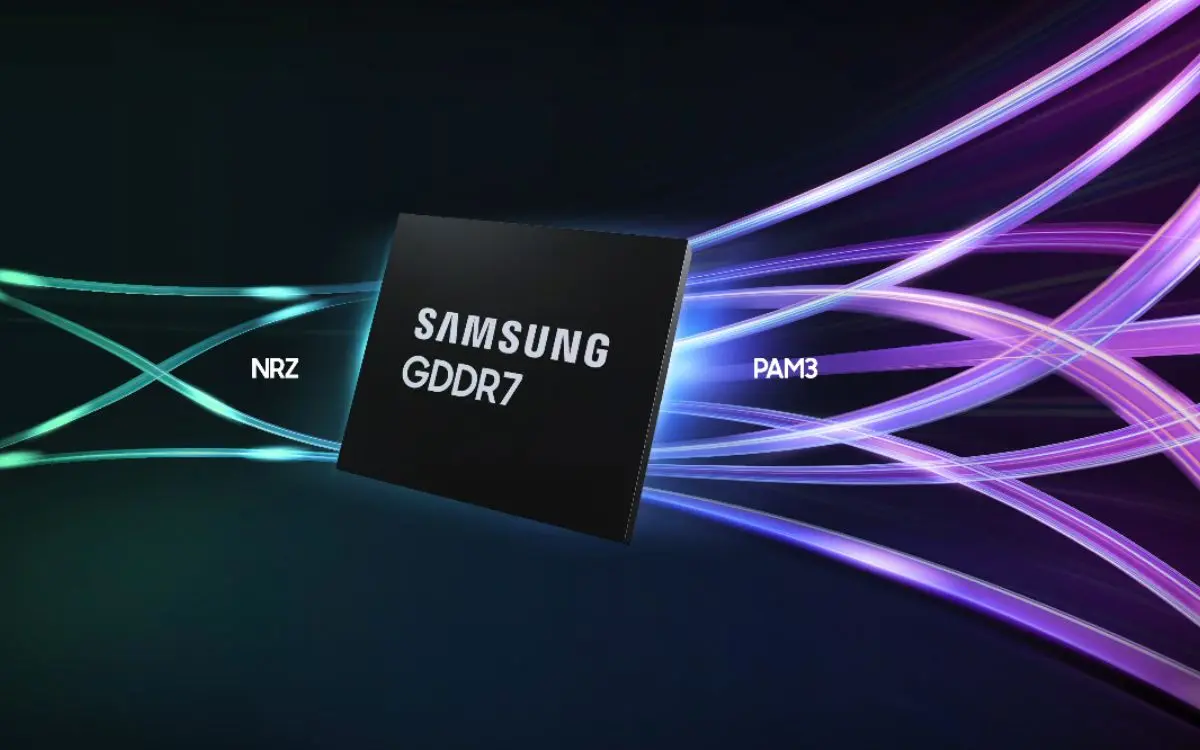
Samsung has quietly begun distributing samples of faster versions of its 24 Gb GDDR7 memory. The company already lists a 24 Gb component with a speed of 28.0 Gbps in mass production.
And now she adds versions with speeds of 32.0 Gbps and 36.0 Gbps in the same 266-bit FBGA packageboth marked as samples.
Each chip offers 3GB of capacity, giving GPU manufacturers a denser option than the 16Gb and 2GB GDDR7 components that dominate first-generation Blackwell cards.

These 3GB modules fit perfectly into today’s workstation layouts and high-end gaming graphics cards. A 512-bit card can reach 96GB using 32 of these packages, while a 256-bit design can reach 24GB with eight chips.
This corresponds to configurations such as RTX PRO 6000 class cards or RTX 5090 laptop GPUs. This does not change the number of memory packages, just the density and speed.
Related News:
Non-market use

There is still no public confirmation that the RTX PRO 6000 uses 24 GB modules from Samsung, and the reviews do not mention a specific supplier. What is known is that the board’s BIOS already includes IDs for GDDR7 from Samsung, SK hynix and Micron.
This gives NVIDIA and its card partners the freedom to switch memory vendors as prices and availability change. Meanwhile, Samsung’s new 3GB samples expand the range of possible configurations for future versions and new cards.
The faster GDDR7 modules, with a capacity of 24 GB, could theoretically be used in the future RTX 50 SUPER update. However, rumors suggest that NVIDIA delayed the launch due to memory supply constraints and price increases.
Anyone who follows the site knows that memory prices are rising and, in the US, 64 GB already costs more than a PS5. Although Samsung’s news does not necessarily affect the price of RAM, it may help to prevent GPUs from increasing in price.
RX 9070 XT models still use GDDR6, costing R$5,099.99 (XFX Mercury) and R$5,649.99 (ASRock) at Kabum, and this means they should not be affected. However, the 50 series could benefit from more affordable prices (or at least stable prices).
Although an RTX 5070 can be purchased for R$3,699.99 (MSI 12 GB Shadow 2x OC), prices for the RTX 5090 easily reach R$20,000. An AORUS MASTER ICE, for example, costs R$ 18,999.99. In this case, having an additional supplier contributes to healthier competition and, mainly, to maintaining prices.
Source: Samsung.
*The sale of products indicated on this page may generate commission for Adrenaline.

Join the Adrenaline offer group
Check out the main offers on hardware, components and other electronics that we found online. Video card, motherboard, RAM memory and everything you need to build your PC. By joining our group, you receive daily promotions and have early access to discount coupons.
Join the group and take advantage of promotions
Source: https://www.adrenaline.com.br/samsung/samsung-inicia-producao-de-memorias-gddr7-em-larga-escala/