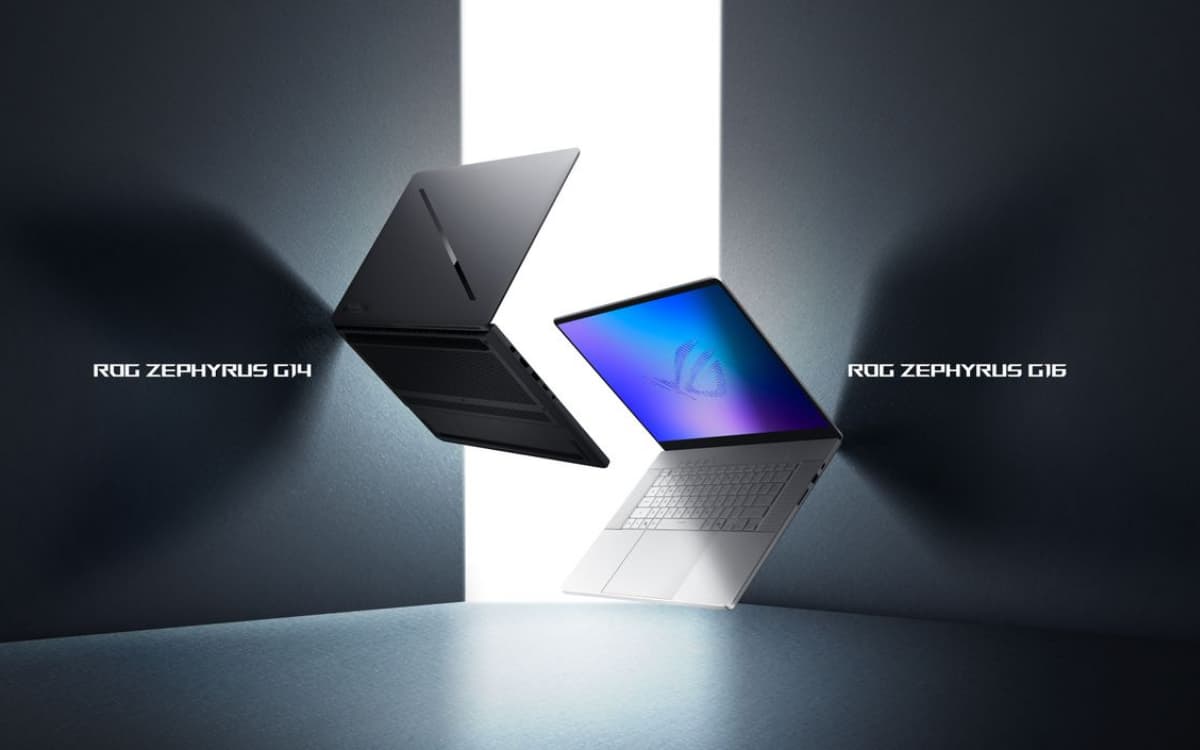
A ASUS presented at CES 2026 the deepest update in the line ROG Zephyrus of recent years. The announcement includes the return of ROG Zephyrus Duo with two full-size OLED screens, plus important model revisions G14 e G16which start to adopt new processor options Intel e AMDkeeping GPUs from NVIDIA.
The strategy indicates a clear attempt to differentiate portable gaming notebooks in an increasingly saturated market, betting on less conventional formats, gains in thermal efficiency and greater flexibility of use between creative work and games.
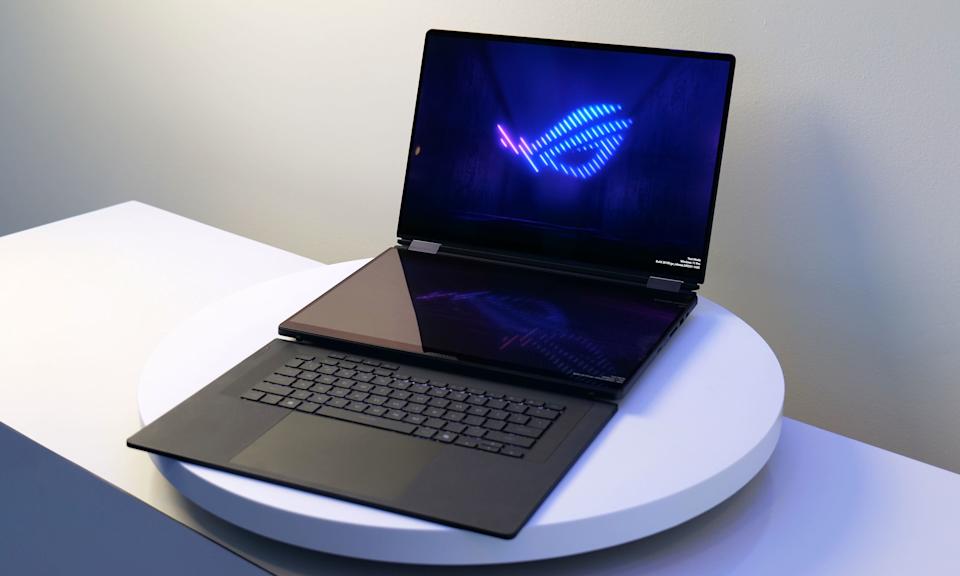
The main highlight of the line is the ROG Zephyrus Duo 2026which abandons the concept of a narrow secondary screen adopted in previous generations and starts using two 16-inch OLED screensboth with resolution 3K (2880 × 1800)update rate 120 Hzsupport HDRmaximum brightness of up to 1.100 nits and compatibility with NVIDIA G-Sync.
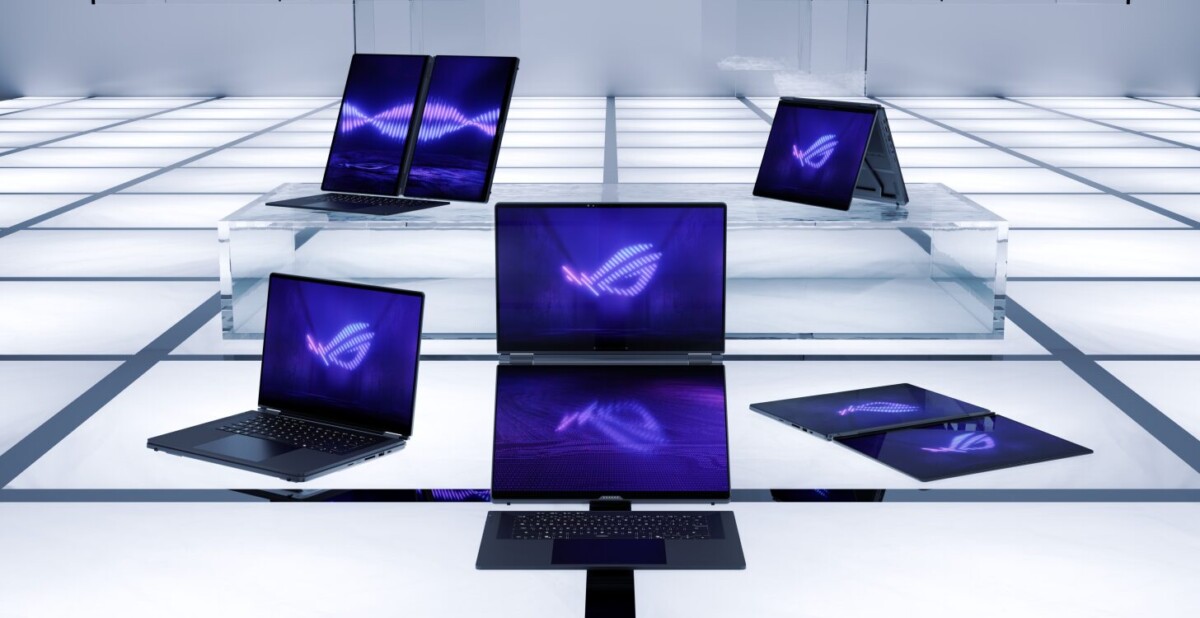
The screens are stacked using a traditional hinge, reminiscent of the Zenbook Duo concept, but with hardware clearly aimed at gamers and content creators.
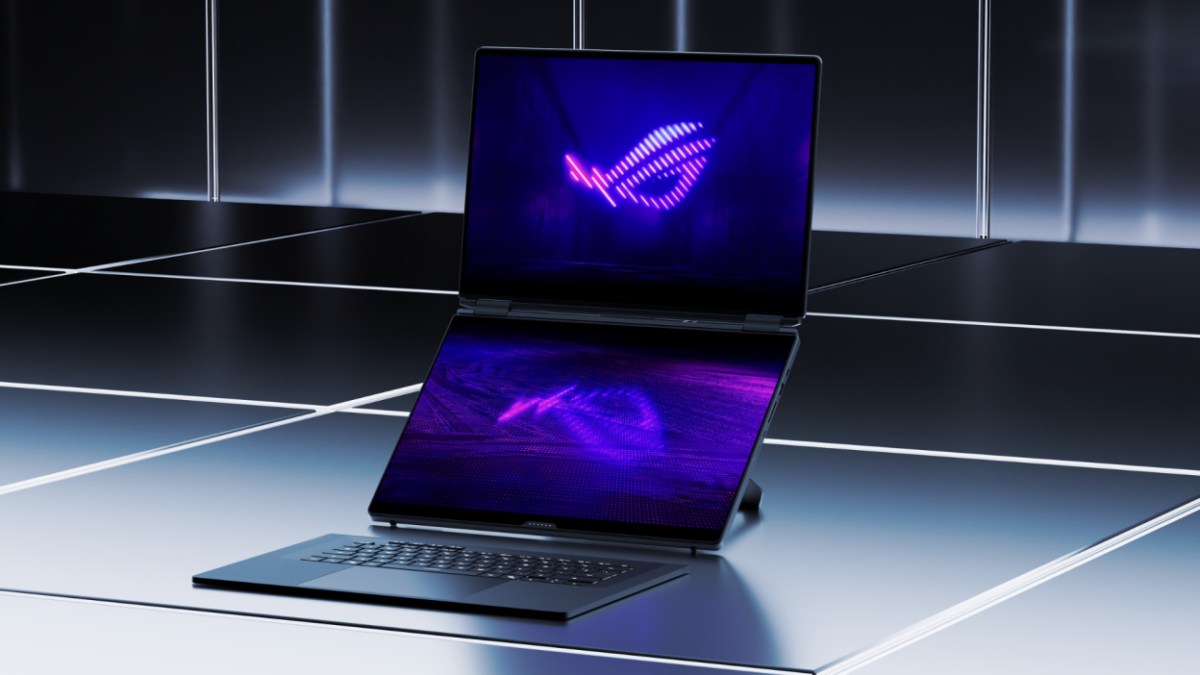
The new format allows different modes of use, such as overlapping screens, vertical side-by-side arrangement, tent mode, flat use on the table or operation as a conventional notebook with only one active screen.


Cutting-edge hardware with calculated thermal limits
Under the hood, the Zephyrus Duo can be configured with processors Intel Panther Lake (Core Ultra Série 3)reaching the Core Ultra X9 388Hcombined with GPUs GeForce RTX 5090 Laptop.
Graphics power is limited to 135 W de TGPa lower value than traditional single-screen gaming notebooks, but consistent with the portability proposal and the presence of two active screens.
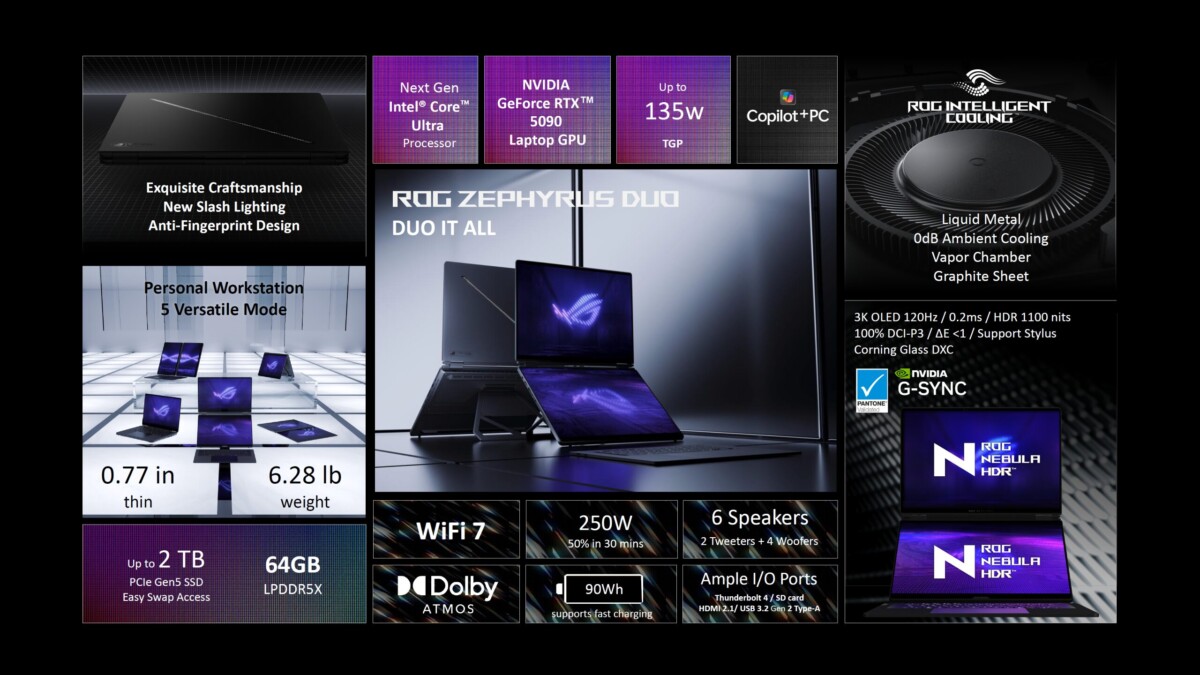
The platform accepts up to 64GB LPDDR5x memory and even 2TB of NVMe storagein addition to connectivity Wi-Fi 7multiple ports Thunderbolt 4HDMI 2.1, USB-A and full-size SD card reader.
According to company representatives during technical briefings at the fair, the focus of the project was to balance sustained performance and thermal control in a chassis of 19.6mm thick e 2,85 kgeven with two OLED screens and a battery 90 Wh.
The model also supports fast charging of 250 Wreaching approximately 50% charge in 30 minutes.
The idea was to treat the Duo as a complete portable station, capable of switching between gaming, heavy multitasking and content creation without requiring external monitors.
ASUS
Detachable keyboard and new usage scenarios
Just like the Zenbook Duo, the keyboard is removableand can be attached magnetically or used wirelessly via Bluetooth.
The decision expands usage scenarios, allowing, for example, playing on one screen while the other displays chats, maps, streaming tools or professional applications.
ASUS also demonstrated experimental modes, such as two-player local matches using tent mode, each with its own screen.
The company recognizes that this type of use depends on software compatibility and can impact performance, but sees potential in specific genres, such as fighting games and local cooperatives.
Notebook technical sheet ASUS ROG Zephyrus G14 (GU405)
| Specification | Details |
|---|---|
| Model | ASUS ROG Zephyrus G14 (GU405) |
| Operating system | Windows 11 Pro |
| Bodies | ROG Nebula HDR |
| Size/format | 14 inches, 16:10 |
| Resolution | 2880 × 1800 (3K) |
| Technology | OLED |
| Refresh Rate | 120 Hz |
| Maximum brightness | Until 1.100 nits |
| Color coverage | DCI-P3 100% |
| HDR certification | VESA DisplayHDR™ True Black 1000 |
| Color accuracy | Delta E |
| Response time | 0,2 ms |
| Processor | Next-Gen Intel® Core™ Ultra |
| Graphics card | Until NVIDIA® GeForce RTX™ 5080 Laptop GPU |
| RAM memory | 16 GB / 32 GB / 64 GB LPDDR5X 8533 MT/s (dual channel, onboard) |
| Storage | 1× M.2 PCIe® Gen4 x4 SSD, até 2 TB |
| USB-C ports | 1× Thunderbolt™ 4 (DP 2.1 + PD 3.0 até 100 W) |
| 1× USB-C 3.2 Gen 2 (DP 2.1 + PD 3.0 up to 100 W) | |
| USB-A ports | 2× USB 3.2 Gen 2 Type-A |
| Video | 1× HDMI® 2.1 FRL |
| Card reader | SD card full size (UHS-II, até 312 MB/s) |
| Audio | Combo jack (3,5 mm) |
| Additional connector | Rectangle Connector |
| Keyboard | RGB the 1 zone |
| Key travel | 1,7 mm |
| Wireless connectivity | Wi-Fi 7 e Bluetooth 6.0 |
| Audio system | 6 speakers (2 tweeters + 4 woofers) |
| Battery | 73 Wh |
| Source | AC adapter 250 W |
| Construction | Chassis in CNC aluminum |
| Dimensions | 31,1 × 22,0 × 1,59 ~ 1,83 cm |
| Weight | 1.5 kg to 1.58 kg (varies depending on configuration) |
Zephyrus G16 and G14 gain technical update and design adjustments
In addition to the Duo, ASUS has renewed the ROG Zephyrus G16 e G14maintaining the line’s characteristic slim design, but with internal changes and functional details.
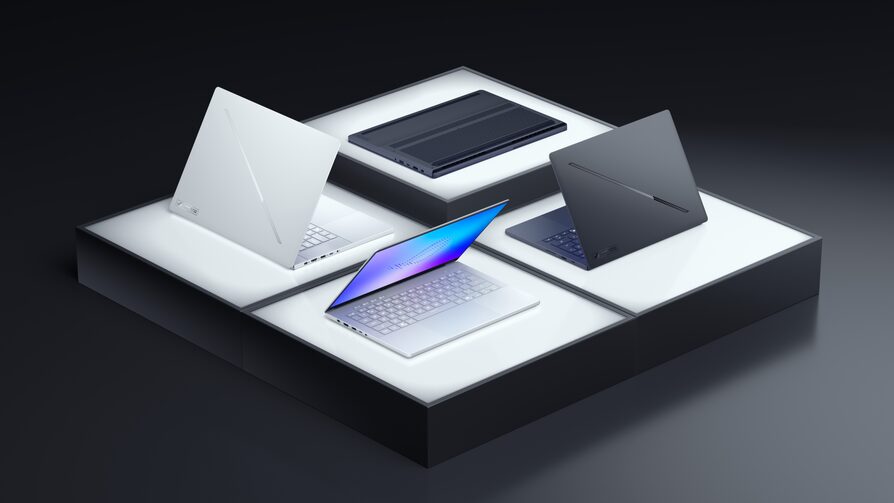
Both now offer Intel Panther Lake processors as an alternative to the already known AMD options, in addition to GPUs from the RTX 50.
O G16 can reach up to RTX 5090 Laptop com TGP up to 160 Wwhile the G14 varies depending on the configuration, reaching RTX 5080 in Intel and RTX 5060 on AMD models.
They both keep screens OLED Nebula HDRnow with factory calibrationincreased brightness and improvements in thermal efficiency.
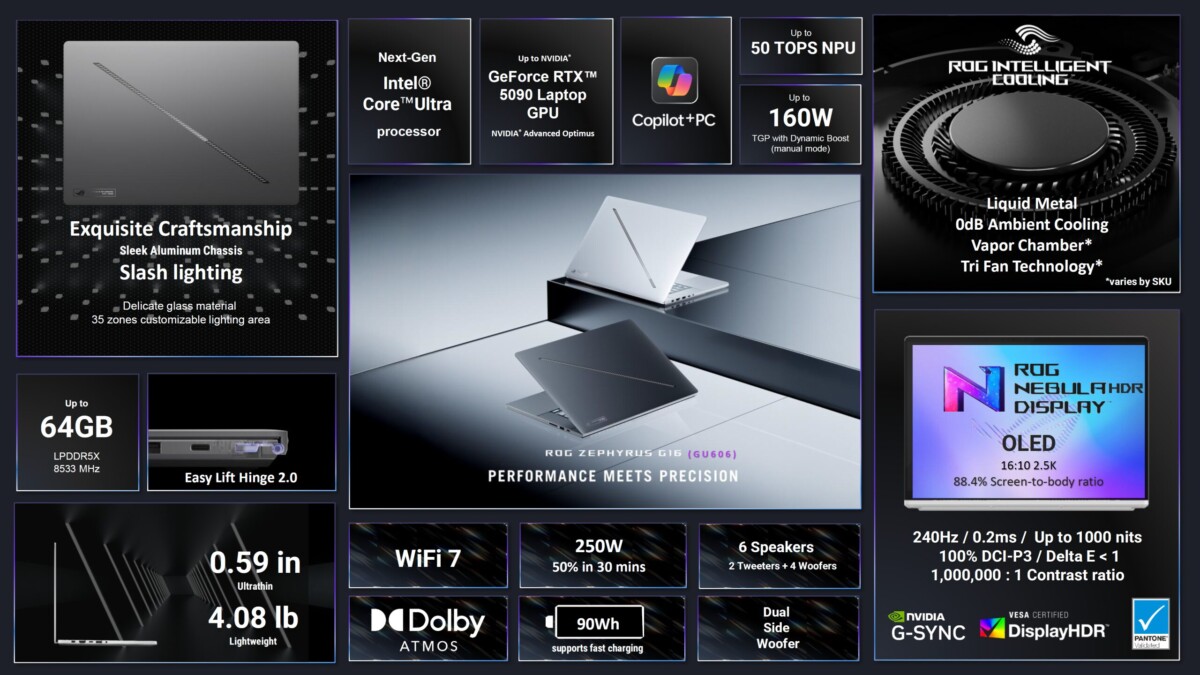
Among the practical adjustments are new hinges that are easier to openredesign of the lower part of the chassis for better airflow and a lighting system on the top with 35 LED segmentscapable of displaying information such as battery level.
The G14 also now has full size SD slotsomething often requested by photographers and creators.
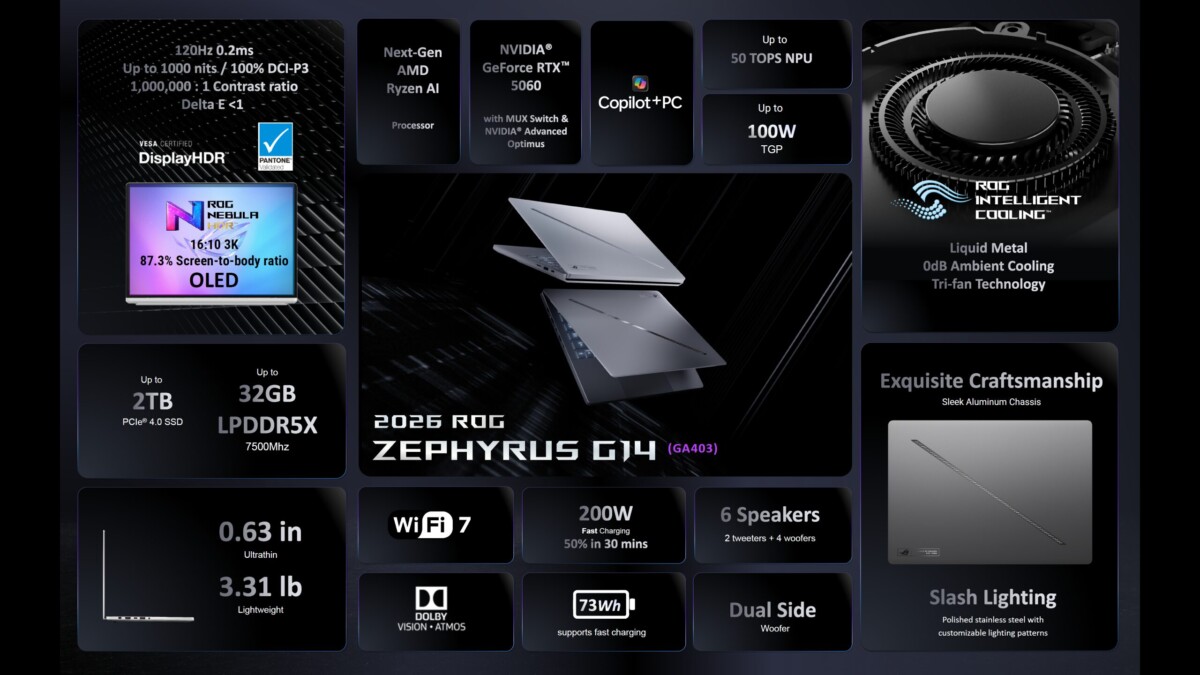
Technical data sheets for ASUS ROG Zephyrus G14 (GA403GM) and G16 (GU606) notebooks
| Specification | ASUS ROG Zephyrus G14 (GA403GM) | ASUS ROG Zephyrus G16 (GU606) |
|---|---|---|
| Operating system | Windows 11 Pro | Windows 11 Pro |
| Bodies | ROG Nebula HDR | ROG Nebula HDR |
| Size/format | 14”, 16:10 | 16”, 16:10 |
| Resolution | 2880 × 1800 (3K) | 2560 × 1600 (2.5K) |
| Technology | OLED | OLED |
| Refresh Rate | 120 Hz | 240 Hz |
| Maximum brightness | Until 1.100 nits | Until 1.100 nits |
| Color coverage | DCI-P3 100% | DCI-P3 100% |
| HDR | VESA DisplayHDR™ True Black 1000 | VESA DisplayHDR™ True Black 1000 |
| Color accuracy | Delta E | Delta E |
| Response time | 0,2 ms | 0,2 ms |
| Processor | Next-Gen AMD Ryzen™ AI | Intel Panther Lake (next generation) |
| Graphics card | NVIDIA® GeForce RTX™ 5060 Laptop GPU | Until NVIDIA® GeForce RTX™ 5090 Laptop GPU |
| RAM memory | 16 GB / 32 GB LPDDR5X 7500 MT/s (onboard, dual channel) | 16 GB / 32 GB / 64 GB LPDDR5X 8533 MT/s (onboard, dual channel)* |
| Storage | 1× M.2 PCIe® Gen4 x4 SSD, até 2 TB | 2× M.2 PCIe® Gen5 (1 TB / 2 TB)*2× M.2 PCIe® Gen4 (1 TB / 2 TB) |
| USB-C / USB4 | 1× USB4® (DP 2.1 + PD 3.0 up to 100 W) | 1× Thunderbolt™ 4 (DP 2.1 + PD 3.0 up to 100 W) |
| 1× USB-C 3.2 Gen 2 (DP 2.1 + PD 3.0 up to 100 W) | 1× USB-C 3.2 Gen 2 (DP 2.1, 10–20 Gbps + PD 3.0 up to 100 W) | |
| USB-A | 2× USB 3.2 Gen 2 Type-A | 2× USB 3.2 Gen 2 Type-A |
| Video | HDMI® 2.1 FRL | HDMI® 2.1 |
| Card reader | microSD (UHS-II, up to 312 MB/s) | SD card full size (UHS-II) |
| Audio | Combo jack 3,5 mm | Combo jack 3,5 mm |
| Additional connector | Rectangle Connector | — |
| Keyboard | RGB the 1 zone | RGB the 1 zone |
| Key travel | 1,7 mm | 1,7 mm |
| Connectivity | Wi-Fi 7, Bluetooth 6.0 | Wi-Fi 7, Bluetooth 6.0 |
| Audio system | 6 speakers (2 tweeters + 4 woofers) | 6 speakers (2 tweeters + 4 woofers) |
| Battery | 73 Wh | 90 Wh (4 células, 4S1P) |
| Source | 200 W | 250 W |
| Construction | CNC Aluminum | CNC Aluminum |
| Dimensions | 31,1 × 22,0 × 1,59 ~ 1,63 cm | 35,4 × 24,6 × 1,49 ~ 1,64 cm |
| Weight | 1,5 kg | 1,85 kg |
Redesigned cooling as the central point of the generation
The entire Zephyrus 2026 line adopts an updated cooling system, with steam chamberuse of liquid metal such as thermal interface and hybrid solutions involving graphite and multiple fans.
ASUS claims these changes enable quiet operation at light loads, including sleep modes. 0 dB ambientin addition to greater thermal stability in prolonged use.
The approach indicates a change in priority: less focus on maximum power peaks and more attention to sustained performance in real-world scenarios, especially in thin devices with high energy consumption added by OLED screens.

Also read:
Experiment that could redefine mobile gaming notebooks
The line ROG Zephyrus 2026 reaches the market between middle and end of the second quarterwith prices not yet announced.
In the case of the Zephyrus Duo, the expectation is for high values, compatible with the complexity of the project and the more niche target audience.
Still, the return of the Duo in a truly functional format suggests that ASUS is willing to test design limits in a historically conservative segment.
In a market where gaming notebooks tend to look more and more like each other, betting on two full-size OLED panels It may not be a solution for everyone, but it points to different paths for the evolution of the high-performance portable format.
Fonte(s): Asus
Source: https://www.adrenaline.com.br/asus/asus-rog-zephyrus-ces-2026-telas-duplas-oled-intel-amd/