
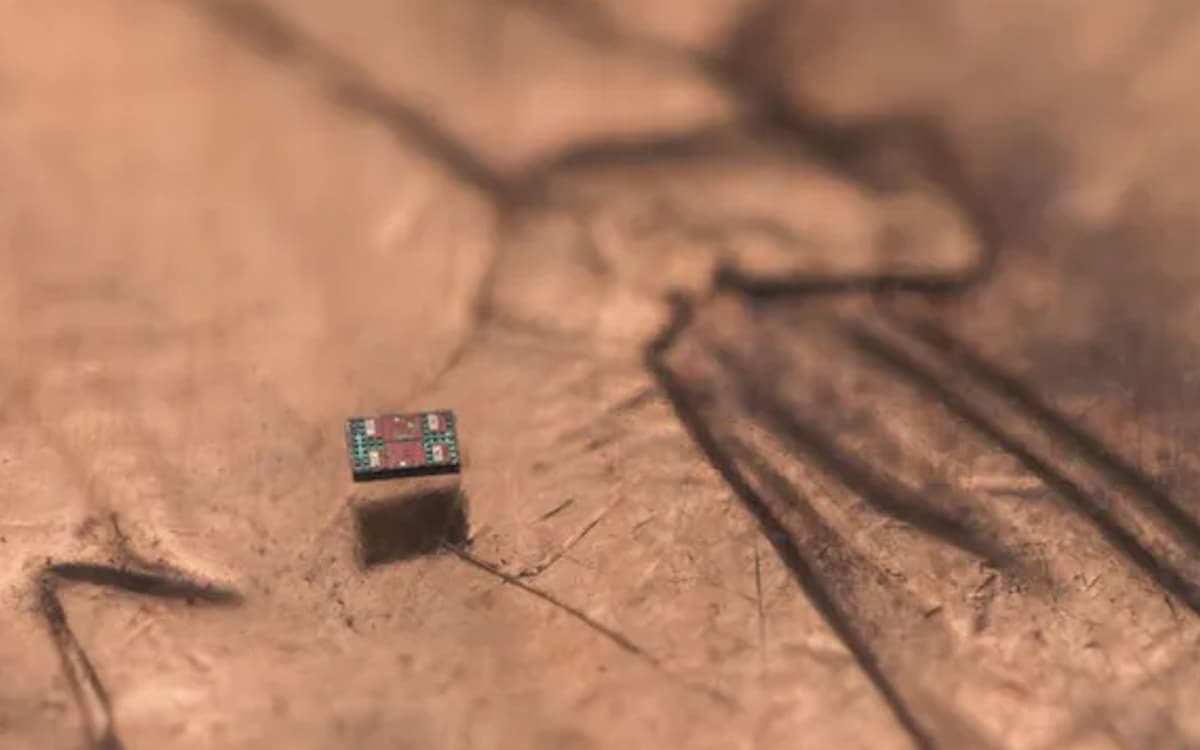
Researchers at the University of Pennsylvania and the University of Michigan developed the smallest autonomous microscopic robots and programmable devices in the world.
Com dimensions smaller than a grain of saltthese microscopic machines use solar energy and an innovative propulsion system to move. The project wants to transform areas such as medicine and microscale manufacturing, with a production cost estimated at just one cent per unit.
The collaborative work shared vital responsibilities: the Penn Engineering team designed the physical structure and locomotion system, while Michigan scientists provided the machine intelligence.
The Michigan laboratory even holds the record for creating the smallest computer in the world, expertise applied directly to this new hardware advancement.
Engineering invisible to the naked eye
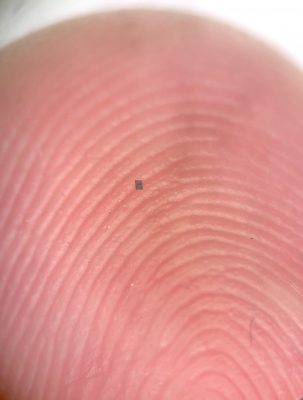
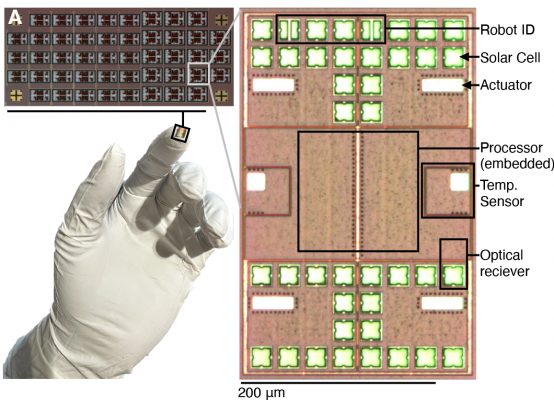
The robots measure approximately 200 x 300 x 50 micrometers. Due to this tiny scale, comparable to that of biological microorganisms, the laws of physics act differently on them. The viscosity of fluids, for example, becomes a much greater obstacle than for human-scale objects.
To overcome this, engineers created a system of ion propulsion. Instead of using moving parts such as arms or gears, which would be fragile and complex to manufacture, robots generate an electric field.
The field pushes ions in the surrounding solution, allowing the device to “swim.” The absence of moving mechanical parts significantly increases the durability of the equipment, which can even be handled with micropipettes without suffering damage.

Solar intelligence and communication
To be considered autonomous, these devices need internal processing. This is where technology from the University of Michigan comes in.
The robots are equipped with processor, memory and onboard sensors. Programming is done through pulses of light, taking advantage of the solar cells that cover most of the robot’s body.
As the system operates with only 75 nanoWatts of powerefficiency is paramount. To extract the data collected by the sensors, the scientists programmed the robots to perform a type of “dance”, inspired by the behavior of bees.
The robot’s physical movements transmit the processed information, eliminating the need for radio transmitters that would consume a lot of energy.
Medical applications and negligible cost
The first prototypes were tested with temperature sensors, but the platform allows the integration of different types of analytical sensors. This opens doors for health monitoring at the cellular level or to acconstruction of microscale structures.
Even with all this technology on board, mass manufacturing promises to be extremely affordable. According to researchers, it is possible to produce these units for around a cent each.
The team says this is just the beginning of a new era for microscopic robotics in the tech space, with the potential to deploy hundreds of units simultaneously to complete complex tasks.
Collective coordination and unique addressing
A significant technical difference lies in the capacity for individual programming within a group. Each unit has a unique address, allowing researchers to send specific commands through the light pulses that also power the system.
According to David Blaauw, professor of electrical and computer engineering, this makes scenarios possible where each robot performs a distinct function within a larger joint task, operating in a coordinated manner.

The accuracy of current sensors already detects thermal variations of a third of a degree Celsius, a metric used to assess cellular activity. To report this data, the system uses computing instructions that encode values in the robot’s physical movements.
Cameras attached to microscopes interpret this “dance” to decode readings in real time, validating the effectiveness of wireless communication on a nanometric scale.
Also read:
Platform for the future
At this time, scientists view the current project as a generalist platform. The propulsion system natively integrates with electronics, and the circuitry is compatible with large-scale manufacturing processes.
Marc Miskin, assistant professor at Penn Engineering, defines the current stage as just the “first chapter” of this technology, whose potential is absurdly fascinating.
Fonte: Penn Engineering

Join the Adrenaline offer group
Check out the main offers on hardware, components and other electronics that we found online. Video card, motherboard, RAM memory and everything you need to build your PC. By joining our group, you receive daily promotions and have early access to discount coupons.
Join the group and take advantage of promotions
Source: https://www.adrenaline.com.br/tech/robos-microscopicos-autonomos-medicina/